

I collaborated with an R&D team to create the ultimate guide app for energy-efficient driving behavior.
Overview
What is Eco-Driving?
A driving style that saves fuel and reduces emissions through smoother acceleration, steady speeds, and better anticipation of traffic¹.
Why Does It Matter?
Transportation is a major source of CO₂ emissions. Eco-driving can cut fuel use by up to 15-25%, which also significantly lowering emissions².
Why Design UI?
An app can guide drivers to build fuel-efficient habits by raising awareness of poor driving behaviors, delivering feedback, setting goals, and sustaining motivation.
The R&D team built AI to detect eco-driving behaviors in real-time. But AI needs a clear, engaging UI to make insights actionable—and useful—for drivers.
TL;DR: Eco-driving cuts fuel use and CO₂ emissions. My task? Review existing apps and design a stronger experience with fresh, user-centered features.
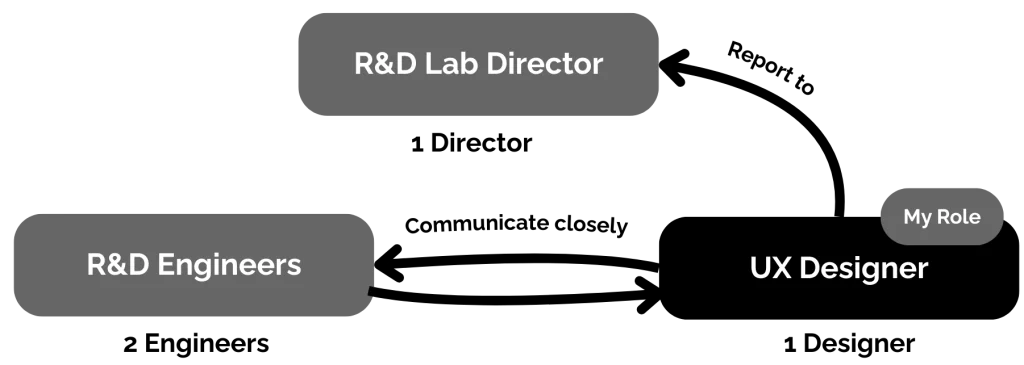
My Role
Sole UX Designer
Tools
Figma + FigJam (Prototyping, Planning), MS Teams (Communication), Python (Data analysis, Visualization).
Constraints
- Time: Aug – Dec 2024 (4 months).
- Scope: Product UI Design
Market Research
Finding the Problem Scope…
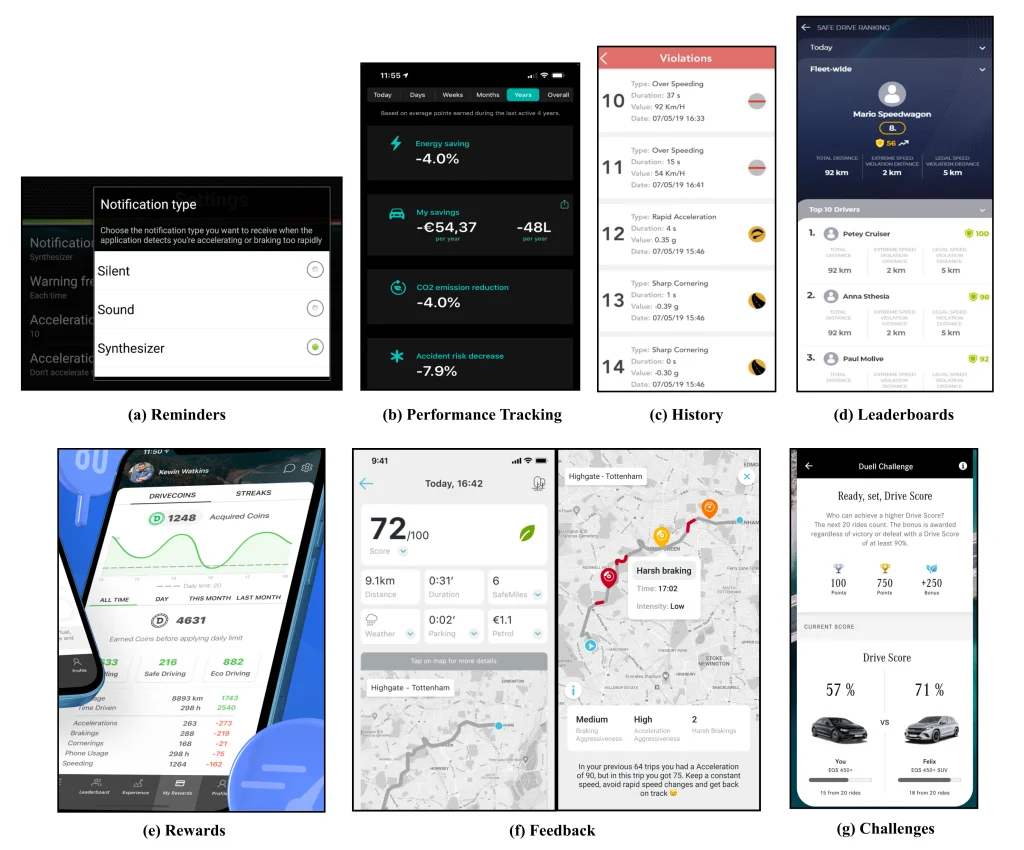
I performed benchmarking on 14 eco-driving apps, uncovering 7 common features and identifying key areas where current solutions might fall short.
| Feature | Description | Apps |
|---|---|---|
| Reminders (n=7) | Customizable notifications prompting users to take specific eco-driving actions or stay on track with their goals. | Mercedes-Benz Eco Coach, GreenRoad Drive, o7drive, LCMM, Root-in, Drive Coach, Ellis-Car |
| Performance Tracking (n=13) | Tracks metrics like fuel savings, CO2 reduction, and trip efficiency to help users monitor and improve their driving behavior. | Mercedes-Benz Eco Coach, GreenRoad Drive, ZenRoad, Eco-Speedometer, Fiat Ciao Drive, Arvento Driver, LCMM, Root-in, Drive Coach, Ellis-Car, IUGO, EQQO, IGI ECO Drive |
| History (n=7) | Maintains a chronological record of user driving data (e.g., traffic violations, routes, etc.). | Mercedes-Benz Eco Coach, GreenRoad Drive, LCMM, Root-in, Drive Coach, Ellis-Car, IGI ECO Drive |
| Leaderboards (n=5) | Facilitates social comparison by ranking user performance metrics (e.g., fuel efficiency or eco-driving scores) against peers. | GreenRoad Drive, ZenRoad, Arvento Driver, IUGO, Ellis-Car |
| Rewards (n=6) | Provides financial or non-financial incentives (e.g., badges, points) for achieving eco-driving milestones. | GreenRoad Drive, ZenRoad, Root-in, Ellis-Car, Drive Coach, IUGO |
| Feedback (n=14) | Provides users with detailed statistics or driving scores to encourage immediate adjustments and improvement. | Mercedes-Benz Eco Coach, GreenRoad Drive, ZenRoad, Eco-Speedometer, Fiat Ciao Drive, Arvento Driver, LCMM, Root-in, Drive Coach, Ellis-Car, IUGO, EQQO, IGI ECO Drive, o7drive |
| Challenges (n=5) | Introduces structured tasks, goals, or competitions which may focus on achieving specific milestones, such as reducing emissions over a week, and can include peer or group-based participation. | ZenRoad, Fiat Ciao Drive, Root-in, Drive Coach, IUGO |
The ‘Behavior Change’ in Adopting Eco-Driving is Overlooked
Changing driving behavior is difficult because habits are automatic³ and deeply ingrained. For example, drivers struggle to shift from:
-
Speeding ➡️ to maintaining steady speeds
-
Aggressive braking ➡️ to anticipating traffic flow
While most eco-driving apps point out mistakes (e.g., “You braked too hard”), they often fail to guide users on how to improve or help them build lasting habits.
User Journey for Eco-Driving
Since breaking automatic habits (e.g., tendency to brake harshly) takes more than just surface-level feedback, I turned to behavioral science for answers.
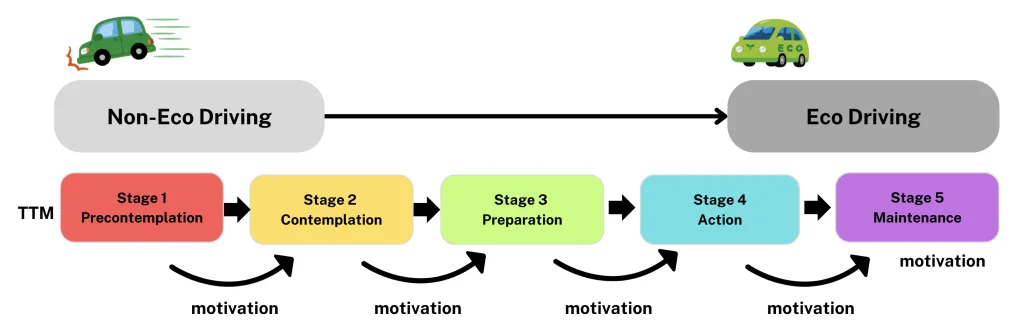
With no existing product to observe a concrete user journey, I mapped the eco-driving habit formation process using the Transtheoretical Model (TTM)⁴—a framework showing how people progress from inaction to forming new, lasting behaviors.
Not Instant Switch, but Gradual Process
The user is unaware or uninterested. Here, we need to raise awareness about eco-driving benefits (e.g., saving fuel, reducing emissions) to get their attention.
The user is aware but still undecided. We must encourage reflection on how eco-driving aligns with their values (e.g., saving money, helping the environment) to help them consider committing.
The user is ready to take action soon. This is where we provide guidance (e.g., eco-driving tips) and help them set achievable goals (e.g., reduce fuel use by 10%).
The user is applying new behaviors. We reinforce their efforts with actionable feedback (e.g., “Smooth acceleration improves fuel efficiency”) and support their regular practice.
The user is trying to stick to eco-driving habits long-term. We monitor progress, reward successes, and help them overcome setbacks to prevent relapse.
Users won’t naturally transition from “thinking” to “doing” without the right motivation!⁵
That’s why our UX research aims to uncover how existing apps and their features support different stages of behavior change.
UX Research
Question: To what extent do current eco-driving app features support user motivation and behavior change across different stages of habit formation?
- Mixed Method: survey + interaction-based evaluation
- What We Did:
- Recruited 6 participants with diverse driving experiences and age groups. Each participant interacted with 7 common features typically found in existing eco-driving apps.
- To evaluate these features, participants rated how well each one supported behavior change (TTM stages) and motivation on a 1–5 Likert scale (1 = Strongly Disagree, 5 = Strongly Agree).
- Participants were asked to respond to statements such as:
-
-
“This feature encouraged me to reflect on eco-driving benefits and consider adopting it.” (Contemplation)
-
“This feature provided clear steps and tools to help me set goals and begin eco-driving.” (Preparation)
-
Answer: There might be inadequate behavior change support.
We plotted the results on a graph to see how well each feature performed:
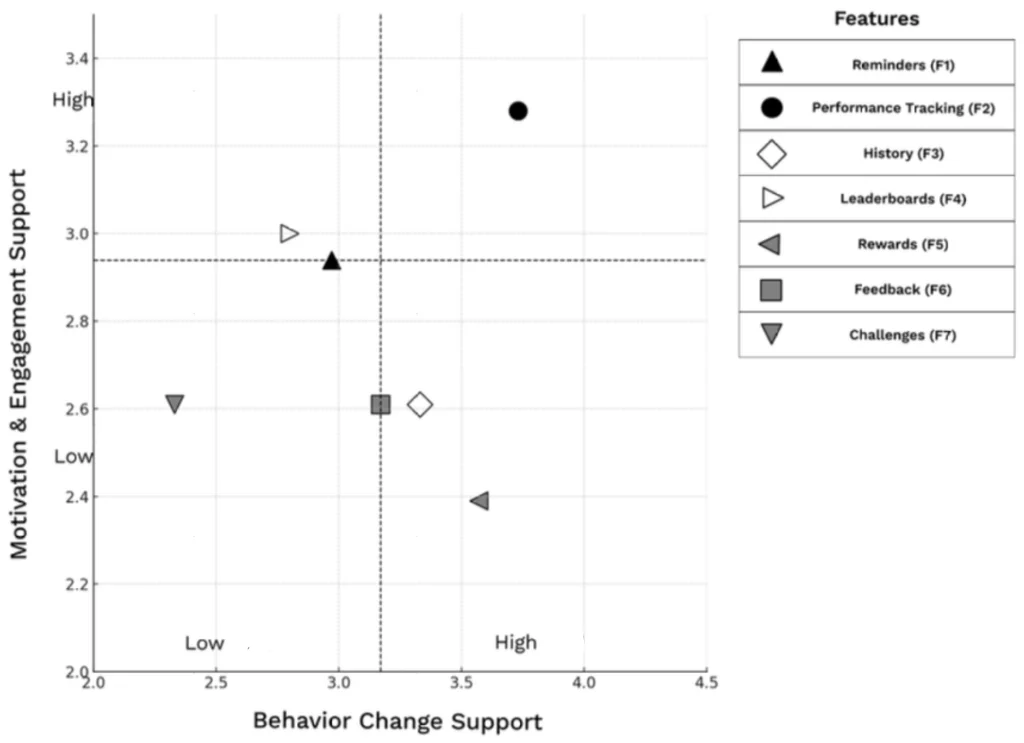
We plotted the results on a graph to see how well each feature performed in two key areas:
-
Behavior Change Support (X-axis): How well the feature helps users learn and change their habits.
-
Motivation Support (Y-axis): How well the feature keeps users engaged and motivated.
Here’s what the graph showed:
- Performance Tracking (F2) is the star feature. It helps users stay motivated and supports behavior change very well.
- Reminders (F1) and Leaderboards (F4) do okay. They help with motivation but don’t strongly push behavior change.
- History (F3) and Feedback (F6) are just average. They don’t stand out much for motivation or behavior change.
- Challenges (F7) and Rewards (F5) perform the weakest. They are low on both motivation and behavior change support.
Qualitative UX Insights
Lack of Personalization & Clear Guidance…
-
Data showed that common features like Rewards and Challenges did not motivate users enough or help them stick to behavior change.
-
Users want Feedbacks to be less generic—they needed it to be contextual and actionable.
-
Gamification related feature, like Leaderboards, made users engage for fun but didn’t help build real habits.
-
Users felt good when ranking high but discouraged when ranking low, and it didn’t improve their eco-driving skills.
-
Product design phase
Brainstorming
(1) Adopt vs. Adapt
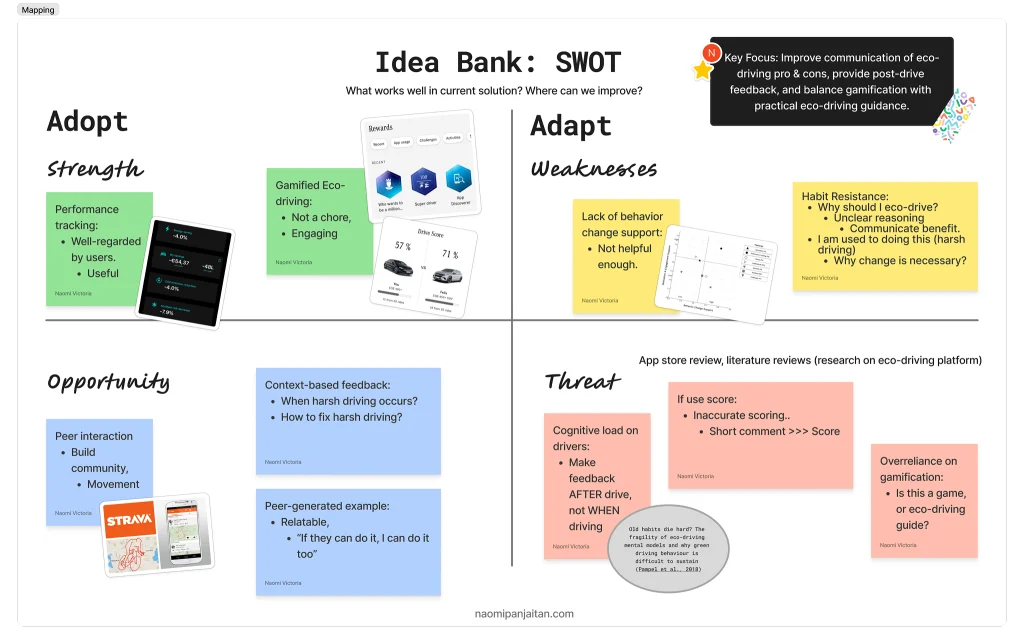
I like to utilize a SWOT-style Idea Bank that organizes research insights into Adopt / Adapt categories, combining strengths, weaknesses, opportunities, and threats of current eco-driving app solutions.
(2) User Archetype & Design Opportunity
We defined a user archetype to understand who we’re designing for. Then, we matched their needs with insights from the previous idea bank.
The biggest takeaway? “Making a movement” is our key design opportunity. Users struggle with habit resistance and unclear motivation, so we need to help them stay engaged.
This can be achieved through strategies like recognition & rewards, community & social proof, gamification, and more!
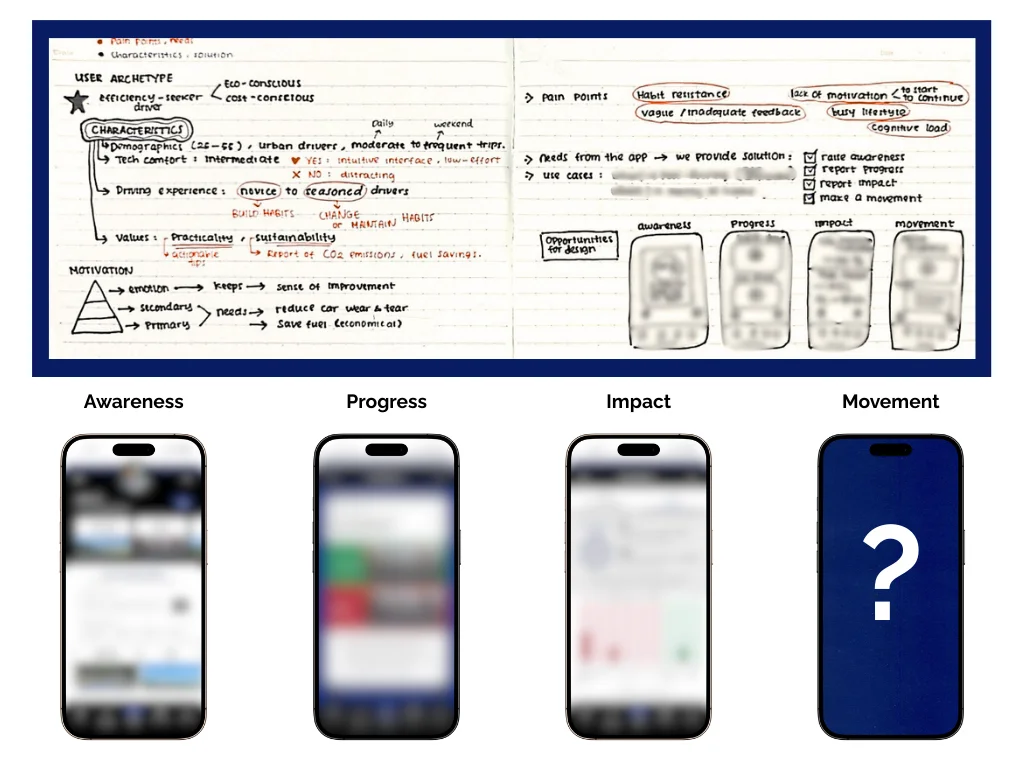
Note: Some screens are blurred as they contain non-publishable materials
Problem Solving
Rethinking What “Movement” Means
- At first, we focused on rewarding users for consistent eco-driving, considering redeemable gifts like bottled water.
- However, one engineer raised a valid point:
“I think such disposable rewards could conflict with our sustainability goals…”
- With that in mind, I had to rethink and propose a new engagement strategy.
Social Recognition as a Solution!
- Initially, I considered gamification, like leaderboards. But our UX research showed that participants felt that it may be demotivating in this context.
- Instead, I shifted to social recognition as a reward system.
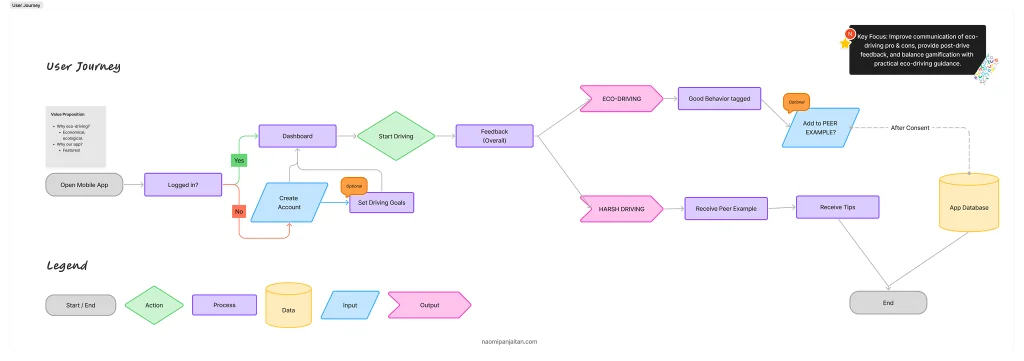
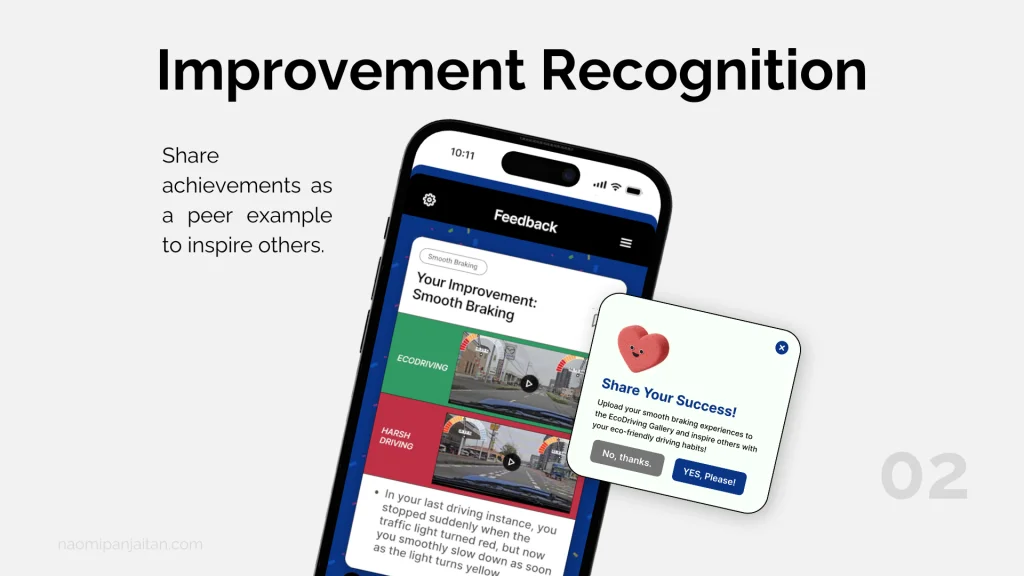
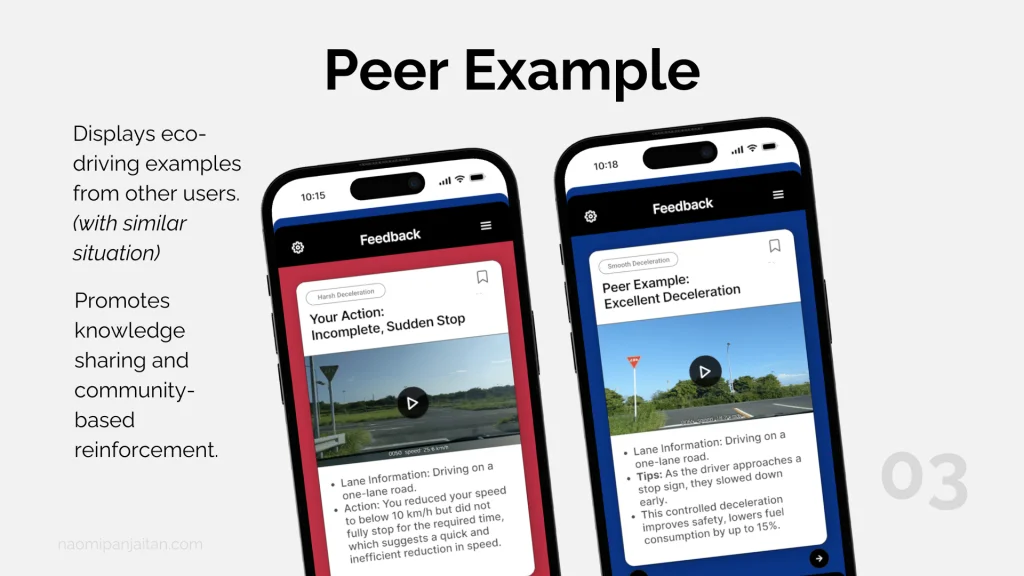
- Drivers are acknowledged as good role models, reinforcing positive behavior. Harsh drivers aren’t punished but are paired with good examples, learning through peer influence.
- This approach leverages behavioral contagion⁶, where individuals adjust their behavior based on others, leading to broader positive change.
Prototyping
(1) User Flow Diagram
I then created a user flow diagram (in FigJam), outlining how the peer example feature would integrate with basic features of the app.
(2) Lo-Fi Wireframes
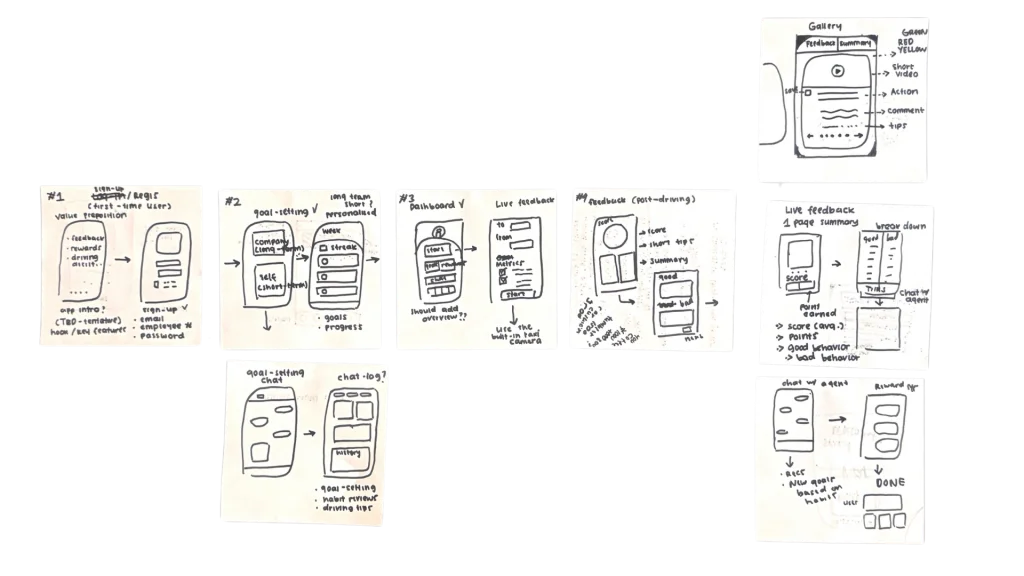
Next, I moved to low-fidelity wireframing using paper, allowing me to easily adjust and reposition elements as needed!
(3) Hi-Fi Prototyping (Figma)
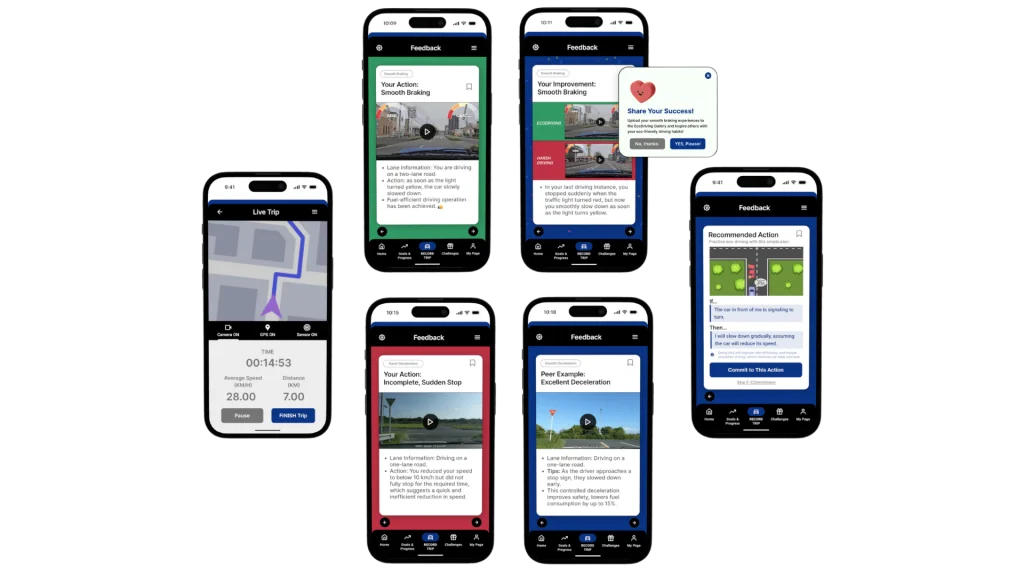
Finally, I created a high-fidelity prototype in Figma to be handed off to the developers. Below are selected key screens showcasing our eco-driving Feedback System.
(4) On-Hand Prototype
Below is a video of the on-hand prototype, demonstrating the eco-driving Feedback System in action. Users get short video clips showing when they drove smoothly/ eco-driving (or when they did harsh-driving)—making learning fast and easy.
Usability Testing Plan
🔍 Purpose
To test whether the app’s design is clear, usable, and effective in helping users build eco-driving habits. This phase bridges the prototype and real-world use.
📁 Details
- UI Validation – Evaluate clarity and usability of key components (e.g., feedback system, social recognition).
-
Behavioral Impact – Assess if features encourage eco-driving habits based on the Transtheoretical Model (TTM).
-
Motivational Design – Understand how gamification and social incentives influence user engagement.
-
Sample Size: 10–15 participants
-
Criteria:
-
Licensed drivers (drive ≥ 3×/week)
-
Mixed age, gender, driving experience
-
Range of eco-driving awareness levels
-
| Objective | Metric | Target |
|---|---|---|
| Usability Satisfaction | SUS Score | ≥ 80 |
| Comprehension Rate | Task success % | ≥ 90% |
| Behavior Change Intention | TTM stage shift (pre vs. post) | +1 stage |
|
Feature Engagement (peer example, etc) |
Likert score | ≥ 4.0 / 5 |
Product Summary
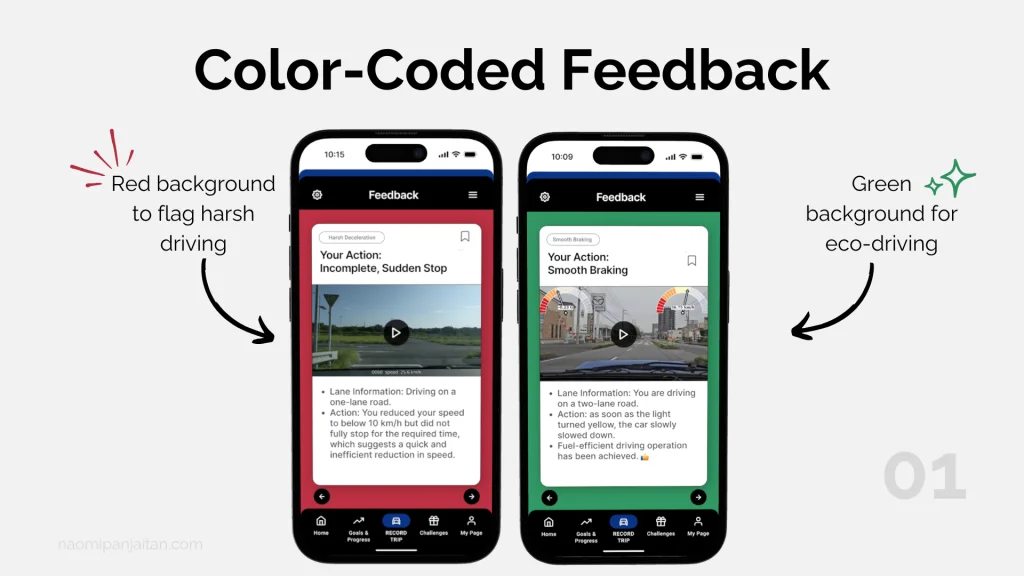
New Feedback System
Summary
As the sole product designer for this eco-driving app, I collaborated with an R&D team to develop an AI-powered product aimed at changing driving behavior. By applying behavioral science, I designed intuitive, actionable features to foster sustainable eco-driving habits. The project resulted in a complete UI design, a research paper, and a patent submission, all delivered within 4 months.
Personal Reflection
- Looking back at the product ideation, I was excited to apply behavioral science concepts (that I studies in grad school) to this project. Using TTM helped me approach the user journey strategically in the secondary research stage—even with no fully app developed yet, I could still map out how users might progress through behavior change stages! 🙂
- If I had more time, I would have involved drivers earlier through co-creation workshops or participatory design sessions—hearing users ideate solutions alongside us could have uncovered deeper pain points and new feature ideas.
References
-
Barkenbus, J. N. (2010). Eco-driving: An overlooked climate change initiative. Energy Policy, 38(2), 762-769. https://doi.org/10.1016/j.enpol.2009.10.021
-
Fafoutellis, P., Mantouka, E. G., & Vlahogianni, E. I. (2020). Eco-driving and its impacts on fuel efficiency: An overview of technologies and data-driven methods. Sustainability, 13(1), 226. https://doi.org/10.3390/su13010226
-
Pampel, S. M., Jamson, S. L., Hibberd, D. L., & Barnard, Y. (2018). Old habits die hard? The fragility of eco-driving mental models and why green driving behaviour is difficult to sustain. Transportation Research Part F: Traffic Psychology and Behaviour, 57, 139-150. https://doi.org/10.1016/j.trf.2018.01.005
-
Prochaska, J. O., & Diclemente, C. C. (2005). The transtheoretical approach. Handbook of Psychotherapy Integration, 147-171. https://doi.org/10.1093/med:psych/9780195165791.003.0007
-
Kennedy, K., & Gregoire, T. K. (2009). Theories of motivation in addiction treatment: Testing the relationship of the transtheoretical model of change and self-determination theory. Journal of Social Work Practice in the Addictions, 9(2), 163-183. https://doi.org/10.1080/15332560902852052
-
Young, J. E. (2020, February 5). Under the influence: How behavioral contagion can drive positive social change. Cornell SC Johnson College of Business. https://business.cornell.edu/hub/2020/02/05/under-the-influence-positive-social-change/
